

The 60-Second Answer
- Full-grain is the intact outer surface of the hide. Nothing sanded off, nothing rebuilt. It is the strongest part of the skin and the only grade that develops a true patina.
- Bonded leather is not a hide at all. It is leather scrap and fibre dust, pulped, bound with polyurethane and rolled onto a fabric backing — typically 10–20% leather content by weight.
- Bonded typically begins flaking within 18–36 months of regular use. Full-grain, maintained, outlives the frame it is stretched over.
- The cheaper sofa is usually the more expensive decision. Run the five-year math before you sign.
There is a specific moment that we have watched play out for three generations of this business. A customer walks into a showroom, sits on two sofas, and finds them almost indistinguishable. One is ₹1.4 lakh. One is ₹4.2 lakh. Both are described, on the tag, as "leather."
They buy the first one. And for about eighteen months, they are delighted with their judgement.
Then the arm rest starts to look tired. A pale line appears where the seat cushion folds. Six months later, that line has become a crack, and the crack has begun to shed — small flakes of what looks like plastic skin, revealing a grey fibrous layer underneath. There is no repair for this. The material has not worn; it has disintegrated.
That is bonded leather. And it is entirely legal to sell it as "leather" in most markets, because it does, technically, contain leather.
The labelling problem: why "leather" tells you almost nothing
The word leather on a swing tag is a category, not a specification. It covers a range of materials whose real-world lifespans differ by a factor of ten or more. In practice, four distinct things are sold under that single word, and only one of them is what most buyers picture when they hear it.
Compounding this, the trade has developed a vocabulary that sounds reassuring but is technically hollow. "Genuine leather" is the clearest example. It sounds like a guarantee of authenticity. In the industry it is closer to the opposite — it is a common descriptor for split leather, the lower layer of the hide, usually surfaced with a printed polymer coating. It is genuine in the sense that it came from an animal. It is not genuine in the sense that most buyers intend.
Other phrases to treat with caution: leather match (real hide on the seating surfaces, vinyl on the sides and back), reconstituted leather and blended leather (both usually mean bonded), and leatherette or PU leather (no hide at all).
Rule of Thumb
If a supplier cannot tell you which grade, which tannery, which finish and which hide thickness in millimetres — the answer is almost never full-grain. Specificity is the tell. Real leather has a paper trail; bonded leather has adjectives.
Anatomy of a hide — where each grade actually comes from
Understanding grades becomes straightforward once you understand that a hide is a layered structure, and that the grades are simply names for which layer you received.
A raw hide has a dense, tightly packed fibre structure at the outer surface — the grain — where the animal's hair follicles sat. Fibres here are fine, interlocked and vertically oriented. This is the strongest, most abrasion-resistant, most water-shedding part of the skin. It is also the part that carries the animal's history: healed scars, insect bites, brand marks, growth wrinkles.
Move downward through the thickness and the fibre structure loosens. The lower layer — the split or corium — is looser, more open, spongier. It is real leather, but it has none of the tensile advantages of the grain and no natural surface at all, because its surface was created by a splitting blade rather than by the animal.
Everything that follows is a consequence of this one fact: strength lives at the top of the hide, and every grade below full-grain is defined by how much of that top has been removed.
The four grades explained
1. Full-grain — the intact surface
Full-grain leather retains the complete outer grain layer, unsanded and uncorrected. Because nothing has been buffed away, natural markings remain visible: a faint scar across a hide, a growth wrinkle at the neck, subtle variation in pore density.
Those markings are not defects. They are the proof of grade. A hide with a perfectly uniform, poreless, machine-even surface has almost certainly been corrected. Nature does not produce uniformity at that scale.
Full-grain requires the best raw material — which is why it represents a small fraction of hides processed globally. A hide destined for full-grain finishing must arrive at the tannery essentially undamaged, which depends on animal husbandry, flaying technique and curing discipline long before it reaches us.
Behaviour over time: darkens, softens, develops a patina, and becomes more characterful. Minor scuffs can be worked back in with conditioning. Structurally, the material is still sound decades in.
2. Top-grain (corrected grain) — the surface, sanded
Top-grain begins as the upper layer of the hide, but the surface is sanded or buffed to remove imperfections, then embossed with a synthetic grain pattern and sealed with a pigmented finish.
The result is consistent, predictable, and easier to match across a large order — genuinely useful for commercial projects where fifty chairs must look identical. But sanding removes the densest fibre layer, and the pigment coating sits on the surface as a film. That film can crack and, once cracked, cannot be repaired invisibly.
Behaviour over time: holds its appearance well for years, then degrades rather than ages. It does not develop a patina, because the surface you are touching is finish, not hide.
3. Split / "genuine leather" — the lower layer
When a hide is split into layers, the lower portion is real leather with no natural grain surface. To make it saleable as upholstery, it is coated with polymer and embossed with a grain print.
It is cheaper, weaker, and prone to delamination where the coating separates from the fibre beneath. From two metres away in good showroom lighting, it can be convincing. Under a fingernail, at a cut edge, it is not.
Behaviour over time: the printed surface wears through at contact points — seat front, arm tops, headrest — exposing a fuzzy, suede-like layer underneath.
4. Bonded — leather in name only
Bonded leather is manufactured, not tanned. Leather offcuts, shavings and buffing dust — the waste stream of the tanning industry — are ground into a pulp, mixed with polyurethane binders, spread onto a fabric or paper backing, and embossed with a grain texture.
Leather content is commonly cited in the range of 10–20% by weight, though there is no universal standard governing the term, and the figure varies widely by manufacturer. The structural material is the binder and the backing. The leather is, functionally, a filler.
Behaviour over time: the polyurethane layer becomes brittle through flexing, heat and UV exposure. It cracks, then peels away in flakes. This typically becomes visible somewhere between 18 and 36 months of daily use, and it is not repairable — patching bonded leather means replacing the panel, and the replacement will not match.
Side-by-side comparison
| Attribute | Full-Grain | Top-Grain | Split / "Genuine" | Bonded |
|---|---|---|---|---|
| What it is | Intact outer hide layer | Outer layer, sanded & embossed | Lower hide layer, coated | Pulped scrap + polyurethane |
| Real hide content | 100% | 100% | 100% (weak layer) | Typically 10–20% by weight |
| Natural markings | Visible, expected | Removed | None (printed) | None (printed) |
| Breathability | High | Moderate | Low | Very low |
| Develops patina | Yes | No | No | No |
| Repairable | Yes — conditioning, refinishing | Partially | Rarely | No |
| Typical useful life* | 15–25+ years | 7–12 years | 3–6 years | 1.5–3 years |
| Failure mode | Ages, softens, darkens | Finish film cracks | Surface wears through | Cracks and flakes off |
| Best for | Heirloom seating, statement pieces | Volume contract work needing uniformity | Low-use decorative items | Short-cycle, cost-led furniture |
*Indicative ranges for domestic upholstery under normal household use with appropriate care. Actual life depends on frame quality, foam density, sun exposure, humidity and maintenance.
Reading about leather only gets you so far.
We'll send physical swatches from our Berlin, Classico and Monaco collections — free, anywhere in India. Flex them, scratch them, hold them to the light. Nothing on a screen substitutes for a hide in your hand.
The five-year cost math nobody runs
The argument for cheap leather is always framed as a saving. It is more accurately framed as a deferral.
Consider a three-seat sofa, used daily by a family, in a typical Indian living room with reasonable natural light.
| Scenario | Upfront | Replacement cycle | Cost over 15 years | Condition at year 15 |
|---|---|---|---|---|
| Bonded sofa | ₹1,40,000 | Every ~3 years | ₹7,00,000 (5 purchases) | On its fifth sofa |
| Split / "genuine" | ₹2,20,000 | Every ~5 years | ₹6,60,000 (3 purchases) | On its third sofa |
| Full-grain sofa | ₹4,20,000 | Reupholster once, optional | ₹4,20,000–5,60,000 | Original piece, better than new |
The figures above are illustrative rather than quoted prices, but the shape of the curve is consistent across markets and price points. The expensive purchase is the one you make repeatedly.
There are second-order costs that rarely make it into the comparison, too: the disposal of four discarded sofas, the disruption of replacing furniture in a finished room, the near-zero resale value of bonded pieces, and — for commercial buyers — the reputational cost of a hotel lobby that looks tired eighteen months after handover.
A Note On Honest Trade-offs
Full-grain is not automatically the right answer for every application. A rental property turning over tenants annually, a temporary retail installation, or a child's playroom bench may be better served by a well-made pigmented top-grain or even a quality synthetic. The point is not that cheap materials are always wrong — it is that the decision should be made deliberately, with the replacement cycle understood, rather than made by accident because a tag said "leather."
Five tests you can do in a showroom in ninety seconds
Look at the cut edge
Find a raw edge — under a cushion, at a seam, behind a panel. Full-grain shows a continuous fibrous cross-section, uniform in colour through its depth. Bonded shows an unmistakable sandwich: a thin coloured skin, a grey-brown pulp core, and a fabric backing. Once you have seen this, you cannot unsee it.
Press with your thumb
Push firmly into the surface. Full-grain and aniline leathers wrinkle in fine, irregular lines that radiate from the pressure point and settle back slowly. Coated and bonded surfaces either don't move, or crease in a single hard fold that stays. Natural material moves like skin; film moves like plastic.
Scratch it lightly with a fingernail
On full-grain and pull-up leathers, a light scratch lightens the surface momentarily and then can be rubbed away with a warm finger — the oils redistribute. On coated splits and bonded material, either nothing happens at all, or you remove a small amount of finish permanently. Ask permission first; a confident supplier will say yes without hesitating.
Examine the pore pattern at close range
Real grain is chaotic. Pore density varies across the hide, follicle sizes differ, and the pattern never repeats. Embossed grain repeats — usually on a cycle somewhere between 10cm and 40cm. Photograph a section with your phone, zoom in, and look for repetition. It is the single most reliable visual test.
Ask three specific questions
"What grade is this hide?" "What thickness in millimetres?" "Which tannery, and can I see the finish specification?" These are ordinary questions in the trade. A supplier who answers precisely is selling something documented. A supplier who deflects to "it's imported" or "it's top quality" is telling you what they do not want to say.
Showroom red flags
- "100% genuine leather" as the headline claim. The strongest phrase available to a full-grain seller is "full-grain." Nobody with full-grain reaches for a weaker word.
- A large sofa at a price that seems impossible. Hide is a commodity with a floor price. A full-grain three-seater requires roughly 16–22 square metres of selected hide before any labour, frame or foam. Arithmetic constrains what is possible.
- Perfect uniformity across every panel. Genuine hides vary. If every centimetre matches every other centimetre, you are looking at a printed surface.
- A strong chemical or solvent smell. Well-finished leather smells faintly sweet and organic. A sharp plastic or adhesive odour usually indicates heavy polyurethane content.
- Warranty language that excludes "peeling," "flaking" or "surface delamination." Manufacturers exclude the failures they expect. Read the exclusions before the coverage.
- Refusal to provide a sample to take home. Any serious supplier will hand you a swatch. Reluctance is information.
Where full-grain earns its price — and where it doesn't
The honest framing is that full-grain buys you three things: lifespan, repairability and improvement with age. Where those three matter, the premium is straightforwardly rational. Where they don't, it isn't.
Full-grain is worth it when
- The piece is used daily and will stay in the family — a primary sofa, a study chair, a dining bench.
- You want the material to look better in ten years than it does on delivery. Only full-grain does this.
- The piece is a visual anchor in the room and its condition sets the tone for everything around it.
- You intend to reupholster the frame eventually rather than replace it.
- You are specifying for a hospitality or commercial space where the material will be photographed, touched by thousands of people, and expected to look intentional rather than worn.
Consider alternatives when
- Absolute colour and texture uniformity across many identical units is a hard requirement — a corrected top-grain will match more reliably than full-grain.
- The application involves heavy exposure to spills, dyes or solvents, where a sealed pigmented surface genuinely protects better than an open aniline one.
- The piece is decorative, rarely sat on, and lifespan is not the governing concern.
- The installation is temporary or the space is expected to be refitted within a few years.
The mistake is not choosing top-grain over full-grain. The mistake is being sold bonded and believing you bought hide.
Frequently asked
-
Is "genuine leather" the same as real leather?
It is real leather in the literal sense — it comes from a hide. But in trade usage "genuine leather" typically denotes split leather with a coated, embossed surface, which sits third of four in the quality hierarchy. It is not a mark of quality; it is closer to a mid-to-low grade descriptor. Judge by the specifics — grade, thickness, finish type — not the phrase.
-
Are the scars and wrinkles on full-grain leather defects?
No — they are the evidence of grade. Any hide with an untouched surface will carry the animal's history. Tanneries grade hides partly by how few of these markings are present, and the cleanest hides command the highest prices, but some natural variation is unavoidable and, to most designers, desirable. If you want zero variation, you are asking for a corrected surface, which means giving up the grain layer.
-
Can bonded leather be repaired once it starts peeling?
Not meaningfully. Once the polyurethane layer begins to delaminate from the fibre backing, the failure propagates — the surrounding material is the same age and has the same brittleness. Filler kits and colour-matched compounds can conceal a small area cosmetically for a few months, but the panel will continue to break down. Reupholstery in a better material is the only durable fix, and at that point the frame quality determines whether it is worth doing.
-
How can I tell the grade of leather I already own?
Check a hidden cut edge for the layered "sandwich" structure that indicates bonded material. Photograph a section of the grain at close range and look for a repeating pattern, which indicates embossing. Press firmly and watch how the surface wrinkles. And check the original documentation or manufacturer's site — the material description is often more specific in the spec sheet than it was on the showroom tag.
-
Does full-grain leather need a lot of maintenance?
Less than most people assume. For most household pieces: dust weekly with a dry cloth, wipe spills immediately, keep it out of direct sunlight and away from heat sources, and condition two to three times a year with a product suited to the finish. Aniline and pull-up leathers benefit from more frequent conditioning in the first six months, when the patina is being established.
-
Is full-grain leather more sustainable than bonded?
The comparison is more nuanced than it first appears. Bonded leather reuses tannery waste, which is a genuine argument in its favour. But it is a composite of hide fibre, polyurethane and textile that cannot be separated, cannot be recycled, and reaches landfill within a few years. Full-grain has a higher material footprint per piece and a far lower one per year of service. Longevity is the dominant variable in furniture sustainability — a piece that lasts twenty-five years generally outperforms one replaced eight times, whatever it is made of.
Hold the difference in your hand.
Three generations of tannery work, condensed into a swatch pack. Compare full-grain against corrected grain, feel the pull-up effect on Monaco, and see what a real cut edge looks like. Delivered free across India.
More Leather Intelligence
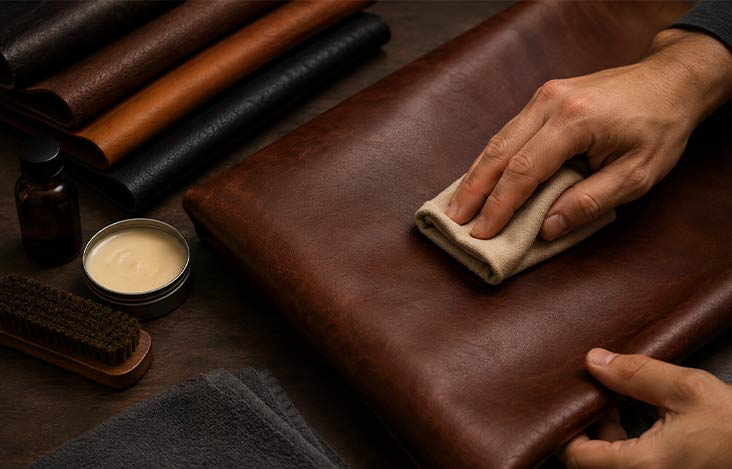
How to Build a Perfect Patina on Your Monaco Leather
Patina isn't age — it's care. The right conditioning routine in the first six months sets the character of your leather for decades.
10 min read · Monaco Collection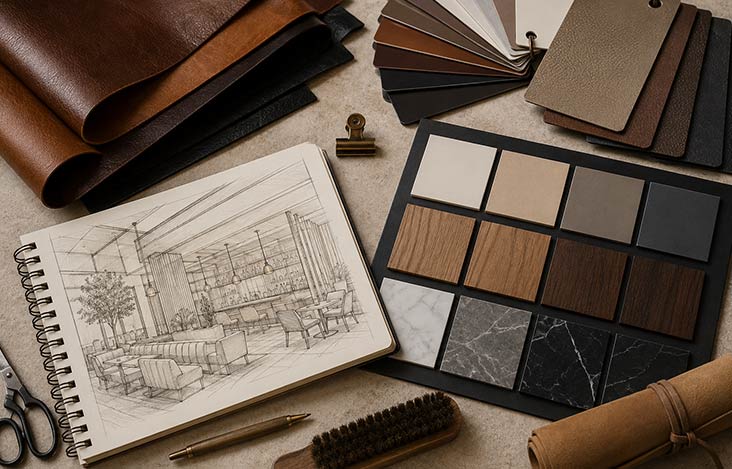
How to Specify Leather for Commercial Projects Without Getting Burned
Rub cycles, hide grades, finish types — a practical guide for interior designers specifying leather for hospitality and commercial spaces.
13 min read · Trade Guide


