

The Short Version
- Most commercial leather failures are specification failures, not material failures. The hide did what it was always going to do; the wrong hide was chosen.
- Abrasion figures are a screening filter, not a lifespan guarantee. Two leathers with identical rub counts can behave very differently in a hotel lobby.
- Finish type — aniline, semi-aniline, pigmented — matters more than grade for most commercial applications. Get this wrong and nothing else saves you.
- Order every panel of a project from a single dye lot, plus 10–15% attic stock. Reorders eighteen months later will not match.
- Get the full technical data sheet before you write the material into the drawing set. Not the marketing sheet. The technical one.
A restaurant group we work with once specified a beautiful natural aniline for forty banquette seats. The hide was excellent — genuinely one of the best things our tannery produced that year. Eleven months later the banquettes were blotched, water-marked and had to be recovered at the operator's cost.
The leather did not fail. The specification did. Nobody had asked the question that decides everything in commercial work: what is going to be spilled on this, how often, and by whom?
This guide is the checklist we wish had existed on that project.
Why commercial leather specs fail
In our experience, commercial leather problems cluster into five causes, and only one of them is really about the material.
- Residential thinking applied to commercial use. A domestic sofa takes perhaps 1,500 sitting cycles a year. A hotel lobby chair can take that in a month, from users with no ownership stake in its condition.
- Choosing the finish for the mood board rather than the maintenance regime. Natural aniline photographs beautifully. It also absorbs red wine permanently.
- Specifying by name, not by number. "Tan full-grain leather" in a schedule is not a specification. It is a hope.
- No attic stock. One damaged panel in year two becomes a whole-room recover because the dye lot is gone.
- Compliance discovered at handover. Fire testing is not something you can retrofit onto material already installed.
Abrasion: how to read rub counts without being misled
Two test methods dominate upholstery specification, and they are not interchangeable.
Martindale (EN ISO 12947 / ISO 5470-2) rubs a specimen against a standard abradant in a continuously changing figure-of-eight motion. Results are reported in cycles. It is the dominant standard in Europe, the UK and much of Asia.
Wyzenbeek (ASTM D4157) rubs a specimen back and forth in a single direction. Results are reported in double rubs. It is the dominant standard in North America.
There is no valid conversion formula between the two. Anyone offering you one is guessing. If your project has a numeric abrasion requirement, insist on test data from the method your specification names.
Commonly referenced performance benchmarks:
| Application | Typical requirement | Notes |
|---|---|---|
| Light domestic / occasional | ~15,000–20,000 Martindale cycles | Decorative chairs, headboards, low-traffic seating |
| General domestic | ~25,000–30,000 Martindale cycles | Family sofas, everyday residential seating |
| Contract / heavy duty | ACT heavy-duty guideline: 30,000 Wyzenbeek double rubs or 40,000 Martindale cycles | Hotel rooms, restaurant seating, offices |
| Severe / public high-traffic | 50,000+ Martindale cycles, often 100,000+ specified | Airports, transit, casinos, healthcare waiting areas |
| Automotive | Manufacturer-specific protocols | OEM standards differ from furniture standards; ask specifically |
The Caveat That Matters
Above roughly 40,000 Martindale cycles, higher numbers stop predicting real-world performance meaningfully. A 100,000-cycle result and a 50,000-cycle result rarely produce a visible difference in a hotel over ten years, because abrasion is almost never the actual failure mode in commercial leather. Soiling, staining, colour transfer, sunlight fading, seam stress and cleaning damage are what kill commercial upholstery. Use rub counts to eliminate unsuitable materials — then stop optimising for them and start optimising for cleanability and lightfastness.
Finish type: the decision that actually governs performance
If you take one thing from this guide, take this. Finish type determines how a leather behaves in service far more than grade or rub count does.
| Finish | What it is | Behaviour | Specify for | Avoid for |
|---|---|---|---|---|
| Aniline | Transparent dye, no pigment coat; grain fully visible | Richest depth, develops patina, absorbs everything, marks easily, no stain barrier | Executive offices, private lounges, boutique suites, statement pieces with controlled access | Food & beverage, public seating, anywhere with unsupervised use |
| Semi-aniline | Aniline base with a light pigment/protective top coat | Retains most natural character; meaningful improvement in stain and light resistance | Hotel guest rooms, upscale restaurant booths, lobby seating, healthcare offices | Extreme-traffic public areas where uniformity is required |
| Pigmented | Opaque pigment layer over corrected or full grain | Most consistent colour, most cleanable, most UV-resistant; less depth, no patina | Airports, transit, casinos, healthcare, high-volume F&B, large matched sets | Projects where the design intent depends on natural variation |
| Pull-up / waxed | Oil- and wax-saturated aniline; lightens under stretch | Dramatic two-tone character, ages beautifully, marks very readily | Heritage bars, libraries, boutique retail, design-led spaces where wear is the aesthetic | Any brief requiring an as-new appearance at year three |
| Nubuck / suede | Buffed surface with a raised nap | Exceptional hand feel, extremely vulnerable to soiling and liquids | Vertical surfaces, wall panels, headboards, low-contact decorative work | Any seating surface in a commercial setting |
The most common expensive error in hospitality is specifying full aniline for a public seating area because the sample looked extraordinary in the studio. Semi-aniline gets you most of the visual quality with a fraction of the risk, and in a finished space very few people can tell the difference from more than a metre away.
Get a specification review before you issue the drawing set.
Send us the application, the traffic profile, the maintenance regime and the compliance requirement. We'll come back with a finish recommendation, full technical data, yield estimate and dye lot planning — at no cost, whether or not you buy from us.
Grade, thickness and substance
Three separate variables get conflated in conversation. Specify all three.
Grade
Full-grain retains the intact hide surface; corrected/top-grain has been sanded and embossed; split is the lower layer with a coated surface. For commercial seating, full-grain and corrected top-grain are both legitimate choices depending on whether the brief prioritises character or uniformity. Split leather rarely belongs in a commercial seating specification.
One nuance worth knowing: for a fifty-cover restaurant where every banquette must match, a corrected top-grain will deliver more consistently than full-grain, and specifying full-grain in that context can create a snagging list at handover when the client queries natural markings. If you want full-grain in a matched set, put the acceptance of natural variation in writing at approval stage, with a signed reference swatch.
Thickness
Specified in millimetres. Indicative ranges by application:
- 0.9–1.2mm — automotive, aviation, tightly tailored upholstery, panels requiring sharp folds
- 1.2–1.6mm — general furniture upholstery, the most common commercial band
- 1.6–2.0mm — heavy contract seating, Chesterfields, deep buttoning, high-stress applications
- 2.0mm+ — structural applications, straps, saddlery-derived detailing
Thicker is not automatically better. Over-thick leather in a tailored application will not take a crisp fold and will fight the upholsterer, resulting in bulky corners.
Hide size and usable area
Hides are sold by area, typically square feet or square metres, and vary in size and usable proportion. A hide with a large unusable belly or damaged flank yields less than its stated area. Ask for average hide size and expected usable yield percentage — reputable suppliers have this data.
Light fastness and colour fastness
These two properties cause more commercial complaints than abrasion ever does, and they are routinely omitted from specifications.
Light fastness is measured on the blue wool scale, 1 (very poor) to 8 (excellent). For interiors with meaningful daylight — atriums, window-adjacent banquettes, glazed lobbies — specify a minimum. A rating of 4 or above is typical for interior contract work; 5 or above is preferable where daylight is significant. Pigmented finishes generally outperform aniline here by a wide margin, which is a real argument for pigmented in a naturally lit lobby regardless of aesthetic preference.
Rub fastness (dry and wet crocking) measures whether colour transfers onto clothing. This matters commercially in a way it rarely does domestically — a dark leather chair that marks a guest's light suit generates a complaint, a dry-cleaning bill and a review. Ask for both dry and wet rub fastness figures on any saturated or dark colour.
Perspiration and water fastness matter in warm and humid climates, and in any application where skin contact is prolonged — cinema seating, waiting areas, transit.
Fire performance and compliance
Requirements vary substantially by jurisdiction, building type, occupancy classification and, frequently, by the insurer and the specific local authority. Nothing here substitutes for confirming the applicable requirement with your project's fire consultant and building control authority at the start of the job.
Standards you are most likely to encounter in commercial upholstery work include:
- BS 5852 — ignition source testing for upholstered seating, referenced widely in the UK and in international hospitality specifications. Different ignition sources (cigarette, match, and larger cribs) correspond to different severity levels.
- California TB 117-2013 — smoulder resistance testing for upholstered furniture components, referenced across much of the US market.
- EN 1021-1 / EN 1021-2 — European cigarette and match ignition tests for upholstered furniture.
- Local national standards — India, the Gulf states and other markets each maintain their own requirements for public buildings; confirm which applies to your occupancy class.
Critical Sequencing
Fire performance is a property of the assembly — leather plus interliner plus foam plus frame — not of the leather alone. A compliant leather over a non-compliant foam is a non-compliant seat. Coordinate the fire specification across the whole build-up with your furniture contractor before materials are ordered. Discovering this at handover means recovering the furniture.
Also request, where relevant to the client's sustainability requirements: chemical compliance documentation (REACH and restricted substances lists), tannery environmental certification such as Leather Working Group audit ratings, chrome-free or vegetable-tanned confirmation if specified, and traceability documentation on hide origin.
Yield and quantity math
Under-ordering is the single most common practical failure in commercial leather procurement, and it is entirely avoidable.
Get the upholsterer's cutting estimate, not your own
Leather is cut around natural markings and hide shape, not nested efficiently like fabric off a roll. Only the workshop cutting it can estimate reliably. Ask for the estimate in the same unit the supplier quotes in.
Apply a wastage allowance
Typical wastage on leather upholstery runs 20–35% depending on panel geometry, whether the design requires directional cutting, and how tolerant the specification is of natural markings. Tight-radius and heavily buttoned work sits at the upper end.
Add attic stock: 10–15% above total requirement
This is not padding. It is the difference between replacing one damaged banquette panel in year three and recovering an entire dining room because the dye lot no longer exists. Write it into the procurement schedule and have the client store it flat, rolled grain-out, away from light and heat.
Confirm units and conversion explicitly
Hides are quoted in square feet in some markets and square metres in others. One square metre is approximately 10.76 square feet. A unit error on a large hospitality order is a six-figure mistake, and it happens more often than anyone admits.
Dye lots, batches and reorders
Leather is dyed in batches. Two batches of the same colour reference, produced months apart from different raw hide sources, will differ — sometimes subtly, sometimes obviously under a specific lighting temperature.
- Order the entire project quantity, including attic stock, in a single dye lot. This is the single most important procurement instruction on any leather project.
- Get a signed reference swatch from the actual production lot — not the sample book — approved by the client before cutting begins. Retain a copy on file.
- Approve colour under the project's actual lighting. A leather approved under studio daylight can read noticeably different under 2700K restaurant lighting. Where the lighting design is known, view samples under matching lamps.
- Ask about batch availability for future phases. If the client plans a phase two, discuss whether the supplier can reserve hide or replicate the lot, and get the answer in writing.
- Plan lead times realistically. Custom colour development, tanning, finishing and shipping add up. Ask for the honest production lead time, then check it against the FF&E programme before committing.
The specification template
Copy this into your schedule. Every line should have an answer before the material is issued for construction.
Leather Specification — Required Fields
The last two lines are the ones designers most often skip and most often regret. A hotel housekeeping team that has not been told what to use on an aniline leather will use whatever is on the trolley, and whatever is on the trolley will strip it. Issue a written maintenance protocol at handover. It costs an hour and protects your specification for the life of the project.
Supplier red flags
- No technical data sheet. Not a brochure — a data sheet with test methods and numeric results. If it does not exist, the testing probably does not either.
- Abrasion figures with no stated test method. "40,000 rubs" is meaningless without knowing Martindale or Wyzenbeek.
- Vagueness about the tannery. Traders who cannot or will not name their source cannot guarantee batch consistency or answer a technical query when something goes wrong at month eight.
- Reluctance to provide production-lot samples. Sample book swatches are indicative. Production-lot swatches are contractual.
- Lead times that seem impossibly short. Tanning and finishing take the time they take. An unrealistic promise at quotation stage becomes a programme delay later.
- No willingness to discuss failure modes. Ask any supplier: "what will this look like in five years in this application, and how will it fail?" A specialist will answer specifically. A trader will say it will be fine.
- Warranty exclusions covering the likely failure. Read the exclusions first. They tell you what the manufacturer expects to go wrong.
Frequently asked
-
Can I convert Martindale cycles to Wyzenbeek double rubs?
No. The two tests use different abradants, different motions and different specimen mountings, and there is no accepted conversion. If your specification names a method, obtain test data using that method. Any supplier offering a conversion factor is producing a number, not a result.
-
Is full-grain always the right choice for commercial work?
No. Full-grain is the right choice where character, longevity and repairability are the priorities and the client accepts natural variation. Where the brief demands absolute uniformity across many identical units, or where the maintenance regime is aggressive, a well-made corrected top-grain with a pigmented finish often performs better against the actual project criteria. Specify against the brief, not against a hierarchy.
-
How much attic stock should I really carry?
Ten to fifteen percent of total project quantity is the working range. Lean toward fifteen for hospitality F&B, where individual panel damage is frequent and localised, and where a mismatched replacement panel is highly visible. Lean toward ten for offices and guest rooms. Store it flat or rolled grain-out, in a dry space away from direct light and heat, and log its location in the O&M manual — attic stock that nobody can find is not attic stock.
-
What's a realistic lead time for a custom commercial leather order?
It depends heavily on whether the colour exists, whether the hide is in stock, and the order volume. A stock colour in stock quantity can move quickly; a custom colour development with fire treatment and a large order quantity is a materially longer programme involving sample approval rounds before production even begins. Get a written lead time at quotation stage and build float into the FF&E programme — leather is rarely the item that arrives early.
-
Who is responsible if the leather fails in service?
It depends on the failure. Material defects sit with the supplier. Specification errors — the wrong finish for the application — sit with the design team. Maintenance failures sit with the operator. This is precisely why the written specification, the signed reference swatch and the issued maintenance protocol matter: together they establish what was chosen, what was approved and what care was instructed. Documentation is the cheapest professional insurance available on a project.
-
Can leather work in healthcare or high-hygiene environments?
Pigmented and heavily finished leathers are used in healthcare settings, but the governing constraint is the cleaning and disinfection protocol the facility uses. Some hospital-grade disinfectants degrade leather finishes over repeated application. Before specifying, obtain the facility's actual cleaning product list and have the supplier confirm compatibility in writing — this is a common and expensive oversight.
Specification support, technical data and yield planning.
Three generations of tannery work behind a trade desk that will tell you when a leather is wrong for your application. Send us the brief — traffic profile, maintenance regime, compliance requirement, programme — and we'll come back with a documented recommendation.
Standards, test thresholds and compliance requirements referenced in this guide are indicative and vary by jurisdiction, occupancy classification, insurer and project. Always confirm applicable requirements with your fire consultant, building control authority and material supplier before issuing a specification.
More Leather Intelligence
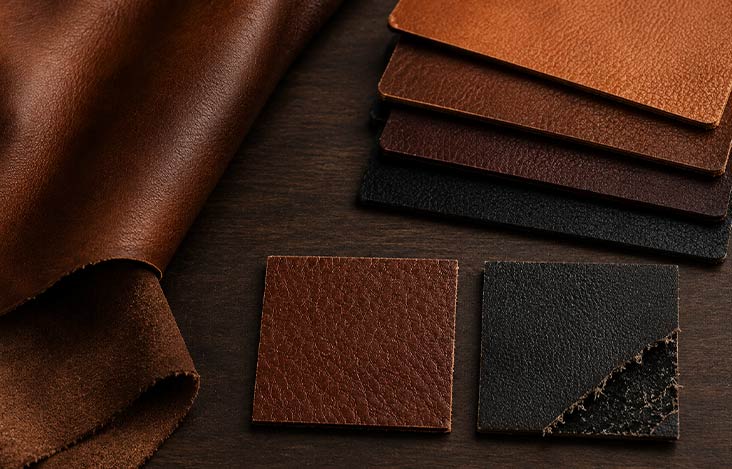
Full-Grain vs Bonded Leather: The Difference That Costs You Thousands
Most consumers can't tell the difference at point of purchase. By year two, the difference is obvious — and expensive.
12 min read · Leather Guide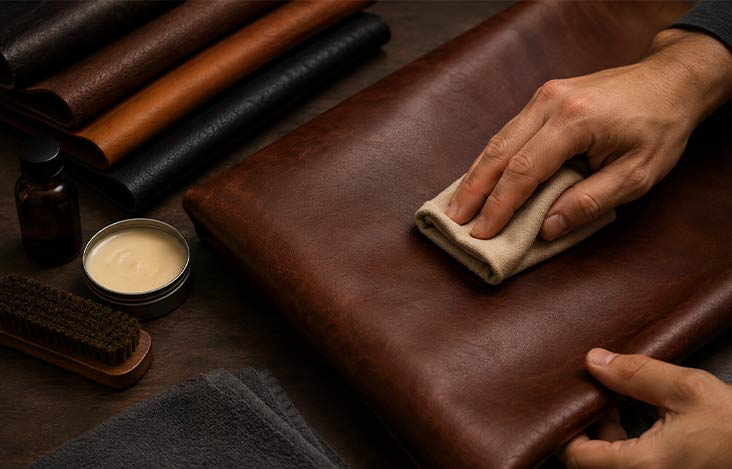
How to Build a Perfect Patina on Your Monaco Leather
Patina isn't age — it's care. The right conditioning routine in the first six months sets the character for decades.
10 min read · Monaco Collection


