

The Short Version
- Patina is oil and wax redistribution under pressure, light and handling — not dirt, not wear, not age alone.
- The first six months decide the character. Conditioning habits set in that window shape how the hide behaves for the next twenty years.
- Under-conditioning produces dry, pale, brittle wear lines. Over-conditioning produces a heavy, greasy, uneven surface. The target is little and often.
- Rotate cushions monthly. Uneven light and uneven pressure are the two most common causes of a patina people dislike.
Most people treat leather care as damage control — something you do after a spill, or when the sofa starts looking tired. With Monaco, that framing gets it backwards. What you do in the first six months is not maintenance. It is the finishing stage of the leather's making, and it happens in your living room rather than in our tannery.
What patina actually is
Patina is often described as leather "ageing well," which is accurate but useless as instruction. Mechanically, it is something more specific.
An aniline pull-up leather like Monaco is saturated with oils and waxes rather than sealed under a pigmented film. Those oils sit within the fibre structure, mobile rather than fixed. When you apply pressure — sitting, leaning, gripping an arm rest — the fibres compress and the oils migrate away from the point of pressure. The area lightens. Release the pressure, add warmth from a hand or ambient heat, and the oils flow back, and the colour deepens again.
Repeat that cycle several thousand times across a seat cushion and you get a surface where oil distribution reflects how the piece has actually been used. Contact points darken and gloss. Edges and folds lighten. The colour becomes tonal rather than flat.
That is patina. It is a map of use, rendered in oil migration. It is also why patina cannot be faked convincingly and cannot occur at all on a pigmented or bonded surface — there is nothing mobile in the material to migrate.
Why Monaco develops it particularly well
Monaco is a full-grain aniline leather treated with oils and waxes to produce a pronounced two-tone pull-up effect. Three properties make it unusually responsive:
- Aniline dyeing. The colour is transparent and penetrates the hide rather than sitting on top of it. Light passes into the material and reflects back through the grain, which is why the colour appears to have depth rather than being a flat coat.
- High oil and wax content. This is what produces the pull-up: the visible lightening when the leather is stretched or flexed. More mobile oil means more dramatic tonal shift.
- Intact full-grain surface. Nothing has been sanded away, so the natural pore structure remains open and the material can breathe, absorb and release.
The trade-off is honesty. Monaco shows everything. A scratch will mark it, a wet glass will mark it, and a hand resting in the same place every evening for a year will leave a visible signature. For the right buyer this is the entire appeal. For a buyer who wants a surface that stays exactly as delivered, Monaco is the wrong choice and a pigmented finish is the right one.
Expectation Setting
In the first eight weeks, Monaco will look less perfect than on day one. Fine scratches appear, the seat begins to show where you sit, and the colour becomes uneven. This is the process working. Owners who panic at week three and over-condition to "fix" it are the ones who end up with a blotchy surface. Hold your nerve.
The six-month window
New Monaco arrives with its oils evenly distributed and its fibres at their tightest. Over roughly the first six months of use, three things happen simultaneously: the fibres relax and take the shape of the frame and foam beneath, the oils begin their first large-scale redistribution, and the surface accumulates its first layer of micro-scratches that will later read as depth.
Whatever pattern establishes during this period becomes the baseline. Correcting it later is possible but slow — you are working against several years of settled oil distribution rather than shaping something still fluid.
The two failure modes are symmetrical:
| Failure | Cause | What you'll see | Recoverable? |
|---|---|---|---|
| Under-conditioned | No conditioning in months 1–6; dry room, air conditioning, sun exposure | Pale chalky lines at cushion folds, stiff hand feel, early surface crazing | Yes, if caught before fibre damage — slow reconditioning over several months |
| Over-conditioned | Conditioning weekly, heavy application, oil-heavy products | Greasy sheen, darkened blotches, attracts dust, loses pull-up contrast | Partially — excess oil must work its way out over months; blotching may persist |
| Uneven exposure | Cushions never rotated; one end in direct sunlight | One panel noticeably lighter or more faded than its neighbours | Difficult — UV fading is permanent |
The month-by-month routine
Weeks 1–2: do nothing
Resist the urge to treat it. The hide needs to acclimatise to your room's humidity and temperature, which can differ substantially from the warehouse it shipped from. Applying conditioner to a hide still equilibrating gives uneven absorption.
Do dust it with a dry, soft cloth. Do use it normally — use is the point. Do keep it at least a metre from radiators, heating vents and direct afternoon sun.
Week 3: the first conditioning
Test on a hidden area first — the underside of a cushion or the rear panel — and wait an hour to confirm the colour response before proceeding.
Then apply a conditioner formulated for aniline or pull-up leather. Use a soft, lint-free cloth, not the sponge that came in the box. Work in small circular motions across one panel at a time. The coat should be so thin that the leather looks barely changed while wet. Leave twenty minutes, then buff with a clean dry cloth until no residue transfers.
Do the whole piece in one session. Conditioning half a sofa and finishing next week is a reliable way to create a visible line.
Months 2–6: build the base
Condition every six to eight weeks, using the same product and the same light-coat technique. This is the period where the base tone is laid down.
Rotate and flip removable cushions monthly. This single habit does more for a good patina than any product. It evens out compression, light exposure and oil migration across the whole piece rather than concentrating it where one person always sits.
Dust weekly with a dry cloth. Every second month, vacuum seams and crevices with a soft brush attachment — grit trapped in a seam abrades the grain from underneath.
Month 7 onward: maintain
Drop to conditioning two to three times a year — realistically, at the start and end of the dry season, plus once more if you run air conditioning heavily. In humid coastal climates twice a year is usually enough; in dry inland or heavily air-conditioned interiors, three is safer.
Keep the weekly dusting. Keep rotating cushions quarterly. Address spills the moment they happen.
Feel the pull-up effect yourself.
Monaco has to be handled to be understood. Flex a swatch and watch the two-tone effect appear and settle. We'll send physical samples from the Monaco collection free, anywhere in India.
What to use — and what to keep away
Use
- A conditioner specified for aniline or pull-up leather. Products designed for pigmented upholstery are formulated to sit on a sealed surface and will not absorb correctly into an open grain.
- Soft lint-free cotton cloths. Two of them — one to apply, one clean one to buff.
- Distilled or filtered water, sparingly, for wiping. Hard water leaves mineral marks on aniline surfaces.
- A soft brush vacuum attachment for seams and crevices.
Avoid
- Saddle soap. Formulated for tack and bridle leather. Too alkaline for finished aniline upholstery and will strip the surface.
- Olive oil, coconut oil and other kitchen oils. They do not cure, they migrate through the hide, and they eventually turn rancid inside the fibre structure. The smell is not reversible.
- Baby wipes and household surface cleaners. Most contain surfactants and alcohols that dissolve the wax layer.
- Silicone-based "leather shine" sprays. They gloss the surface temporarily and block the pores, which prevents future conditioning from absorbing.
- Anything with alcohol, ammonia, bleach or solvent. On aniline leather these lift dye instantly and permanently.
- Hairdryers or heaters to speed drying after a spill. Rapid heat drying shrinks and hardens the fibre.
Always Test First
Every hide takes product slightly differently, and Monaco's aniline dye is transparent enough that a colour shift shows. Test any new product on a concealed area and wait a full hour before committing to the visible surface. This applies even to a product you have used before on a different piece.
Light, heat and humidity
Environment does more damage to leather than use does, and it does it invisibly until it is irreversible.
Direct sunlight is the primary enemy. UV breaks down both the dye and the fibre, and aniline leather has no pigment layer shielding it. A sofa with one end in an afternoon sunbeam will develop a permanent two-tone within a year — and unlike patina, this kind of fading cannot be worked back. Position pieces out of direct beams, or use sheer blinds during peak hours.
Heat sources — radiators, heating vents, fireplaces, and the back of a wall shared with a hot appliance — dry the hide from one side, causing differential shrinkage that shows up as tightness and crazing. Keep a minimum of one metre wherever possible.
Humidity matters in both directions. Heavily air-conditioned rooms pull moisture out of the hide and accelerate drying; conditioning frequency should go up. Very humid coastal environments carry a mould risk in the fibre structure — keep air moving around the piece and don't push it flat against an exterior wall.
Denim and dark textiles transfer dye onto light aniline leather, particularly on pale Monaco tones and particularly when the fabric is new or slightly damp. This is one of the few marks that is genuinely difficult to remove. Worth knowing before choosing a light shade for a heavily used piece.
Troubleshooting
| Problem | What's happening | What to do |
|---|---|---|
| Fresh scratch or scuff | Oils displaced along the scratch line | Rub firmly with a clean finger — body heat redistributes the oils. Most light scratches disappear entirely. If not, a light localised conditioning usually completes it. |
| Water spill | Surface saturation; risk of a tide mark on drying | Blot immediately with a dry cloth, never rub. Then lightly dampen the whole panel evenly and allow to air dry naturally, away from heat. Even wetting prevents a ring. |
| Oil or grease mark | Absorbed into the fibre; no surface film to wipe | Blot excess. Do not apply water. Leave it — over several weeks most oil marks integrate into the surrounding patina and become invisible. If it persists, ask a leather specialist about an absorbent powder treatment. |
| Ink | Dye penetration into an unsealed surface | Act fast and blot. Do not use alcohol or hairspray — both strip the aniline dye and will leave a worse, permanent light patch. This one is worth a professional. |
| Surface feels dry or stiff | Oil depletion, usually from air conditioning or low humidity | Condition, then reassess in four weeks. Repeat if still dry. Resist the urge to apply a heavy coat to fix it in one go. |
| Blotchy dark patches | Over-conditioning; excess oil pooling | Stop conditioning entirely. Buff firmly with a clean dry cloth weekly. The excess will redistribute over two to four months. Do not attempt to remove it with a cleaner. |
| One panel noticeably lighter | UV exposure | Not reversible. Rotate cushions so exposure equalises going forward, and address the light source. |
Frequently asked
-
How long before I see a real patina?
Subtle tonal change appears within two to three months on a piece in daily use. A patina most people would describe as characterful — visible depth, darkened contact points, tonal variation across panels — typically takes twelve to eighteen months. It continues developing indefinitely; a ten-year-old Monaco piece looks materially different from a two-year-old one.
-
Should I condition a brand-new piece straight away?
No. Give it two weeks to acclimatise to your room's humidity first. The hide leaves our tannery correctly conditioned; adding more before it has settled leads to uneven absorption and can produce blotching that takes months to resolve.
-
My leather scratched on the first day. Is that a defect?
No — it is characteristic of aniline pull-up leather and is the direct consequence of the properties that make it desirable. Rub the scratch with a warm finger and it will very likely vanish as the oils redistribute. If a scratched surface would bother you long-term, a semi-aniline or pigmented finish is a better match for how you want to live with the piece, and we would rather tell you that before you order than after.
-
Can I speed up the patina?
Not usefully. Attempts to accelerate it — heat, sun exposure, heavy oiling — produce an uneven, artificial result that then has to be lived with. Genuine patina depends on thousands of small pressure and heat cycles distributed across the surface. The only legitimate accelerant is using the furniture.
-
Is a leather protector spray a good idea?
Generally not on aniline pull-up leather. Protectors work by forming a barrier film, which is exactly what Monaco's finish deliberately avoids. The film blocks the pores, reduces breathability, dulls the pull-up contrast and prevents future conditioning from absorbing. If the piece is going somewhere genuinely high-risk — a dining chair, a household with young children — the better answer is choosing a semi-aniline or pigmented leather for that application rather than trying to seal an aniline one.
-
What about pets?
Claws will mark aniline leather, and deep punctures do not self-heal the way surface scratches do. Some owners find that accumulated pet marks integrate into the overall character and stop registering as damage after a year or two. Others find it upsetting. If pets have unrestricted access to the piece, be honest with yourself about which camp you are in before selecting an aniline finish — and consider keeping claws trimmed and using a throw over favourite spots.
Start with a swatch, not a leap of faith.
We'll send you Monaco samples so you can test the pull-up effect, check the tone against your room's light, and decide properly. Free delivery across India, no obligation.
More Leather Intelligence
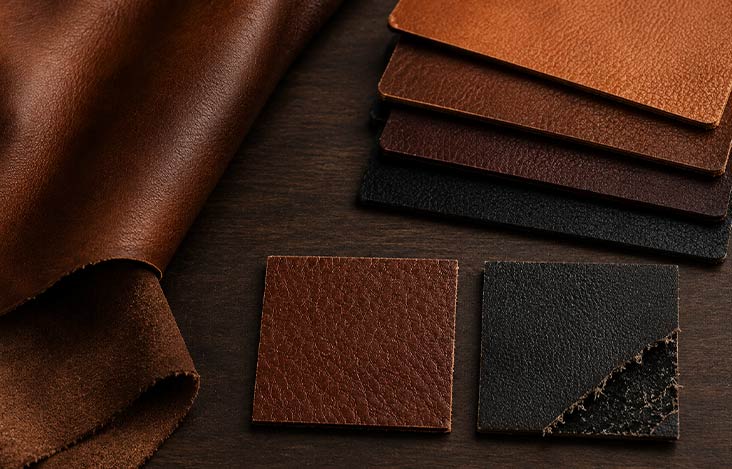
Full-Grain vs Bonded Leather: The Difference That Costs You Thousands
Most consumers can't tell the difference at point of purchase. By year two, the difference is obvious — and expensive.
12 min read · Leather Guide
How to Specify Leather for Commercial Projects Without Getting Burned
Rub cycles, hide grades, finish types — a practical guide for interior designers specifying leather for hospitality and commercial spaces.
13 min read · Trade Guide


